Carrier Oil for Rosemary Oil: How to Mix Rosemary and Argan Oil for Hair

Rosemary essential oil should never go on your scalp straight from the bottle; it needs a carrier oil, and argan oil is a good one. Mix roughly 3 to 6 drops of rosemary oil into a tablespoon of argan oil, patch test it, and massage a small amount into the scalp a few evenings a week. Just keep your expectations honest: rosemary's hair-growth reputation rests mostly on one small trial, and it is worth knowing exactly what that trial did.
The short answer
Any gentle plant oil can carry rosemary oil, and argan is a good choice because it is light, mild-smelling and easy to spread on the scalp. Mix about 3 to 6 drops of rosemary essential oil per tablespoon (15 mL) of argan oil, roughly 1 to 2 percent, patch test first, and never apply rosemary oil undiluted.
Why rosemary oil needs a carrier oil
Essential oils are concentrated, volatile plant compounds. Mayo Clinic's patient guidance says never to apply them directly to the skin or near the eyes, and to dilute them in a carrier oil first.3 The carrier does two jobs: it spreads a few drops of rosemary over a whole scalp, and it brings the concentration down to a level skin tolerates.
Mayo names almond and jojoba as common carriers,3 and either is a perfectly fair choice. Argan oil earns its place for scalp use for practical reasons:
- Light and spreadable. A little covers a lot of scalp without the heavy, waxy feel of thicker oils.
- Mild scent. Cosmetic argan oil is pressed from unroasted kernels, so its scent stays quiet and the rosemary is what you smell.
- Useful on skin, too. Argan oil contains tocopherols (vitamin E compounds), sterols and squalene, and topical use has been reported to soften skin and support hydration.5 That is useful on a scalp you'll be massaging several times a week.
- It does double duty on the lengths. The same bottle goes through dry ends afterward; our guide on how to use argan oil for hair covers the techniques.
Whatever you choose, use a plain, single-ingredient oil. A pre-scented blend adds fragrance you can't measure. Ours is 100% organic, cold-pressed argan oil with nothing added, which makes the dilution math reliable.
How to dilute rosemary oil for hair
Mayo Clinic's handout puts it in teaspoons: one drop per teaspoon of carrier works out to roughly 1 percent, five drops to roughly 5 percent. It treats the 1 to 5 percent range as generally low-risk, while noting that reactions become more likely as you go stronger.3 A tablespoon is three teaspoons, so for a scalp blend:
| Strength | Rosemary oil per 1 tablespoon (15 mL) argan oil | When to use it |
|---|---|---|
| About 1% | 3 drops | Your first blend, or a sensitive scalp |
| About 2% | 6 drops | A comfortable everyday scalp strength once you know you tolerate it |
| About 5% | 15 drops | The upper limit of the usual range; no need to go here for a scalp massage |
Drop sizes vary between bottles, so treat these as approximate and err low. A stronger blend won't work faster; it only raises the odds of irritation. For other essential oils and a fuller ratio table, see our guide to argan oil with essential oils.
How to mix it
- Pour 2 tablespoons (30 mL) of argan oil into a small, clean dark-glass dropper bottle. Don't add essential oil to your main bottle.
- Add 6 to 12 drops of rosemary essential oil for a 1 to 2 percent blend.
- Cap, roll between your palms, and label it with the date.
- Patch test before the first full use. The AAD's method is to apply a quarter-sized amount to the inner arm or bend of the elbow twice a day for 7 to 10 days, and to stop if the skin turns red, itchy or swollen.6
- Store it away from heat and light and mix fresh batches every few weeks.
Rosemary oil for hair growth: what the 2015 trial did and didn't show
Almost every "rosemary beats minoxidil" headline traces back to one study. Here is what it actually involved.
What the trial did
Researchers randomized 100 men with androgenetic alopecia (male-pattern hair loss) to a rosemary oil product or to minoxidil 2%, for six months.1 The rosemary preparation was a lotion standardized to its 1,8-cineole content, and participants applied 1 mL twice a day to the top and front of the scalp. Hair counts were assessed by an investigator who didn't know which treatment each person used.2
What it found
At three months, neither group had a significant change in hair count. At six months, both groups had a significant increase compared with the start, and the difference between rosemary and minoxidil was not statistically significant.1 In numbers, the average count in the rosemary group rose from about 123 to about 130 hairs in the measured area; the minoxidil group went from about 138 to about 141.2 Scalp itching increased in both groups, more so with minoxidil, and neither treatment changed dryness, greasiness or dandruff.1
What it didn't show
- There was no placebo group, so we can't tell how much of the change came from the treatments themselves.
- The comparison was 2% minoxidil, the lower of the strengths sold over the counter.
- It studied a standardized commercial lotion, not drops of essential oil mixed into a carrier at home.
- Only men with one type of hair loss took part, and the size of the counted area wasn't reported.2
- It's one trial. A 2025 review of blinded trials of non-prescription hair loss products found just this one for rosemary oil, noted that no long-term safety data exist, and called for larger, high-quality studies.2
There is a plausible mechanism: a compound in rosemary extract acted as a 5-alpha-reductase inhibitor in an in vivo study,2 the same enzyme pathway some hair loss drugs target. But that is early-stage evidence, not proof. And argan oil, for its part, hasn't been shown to grow hair; its value is in protecting the length you have, as our article on argan oil for hair growth explains.
Rosemary oil is a reasonable thing to try. It isn't a substitute for finding out why your hair is thinning.
A weekly scalp routine with argan and rosemary oil together
The trial ran for six months and saw nothing measurable at three, so consistency matters more than strength. A routine most people can keep up:
- Two or three evenings a week, part dry hair into sections.
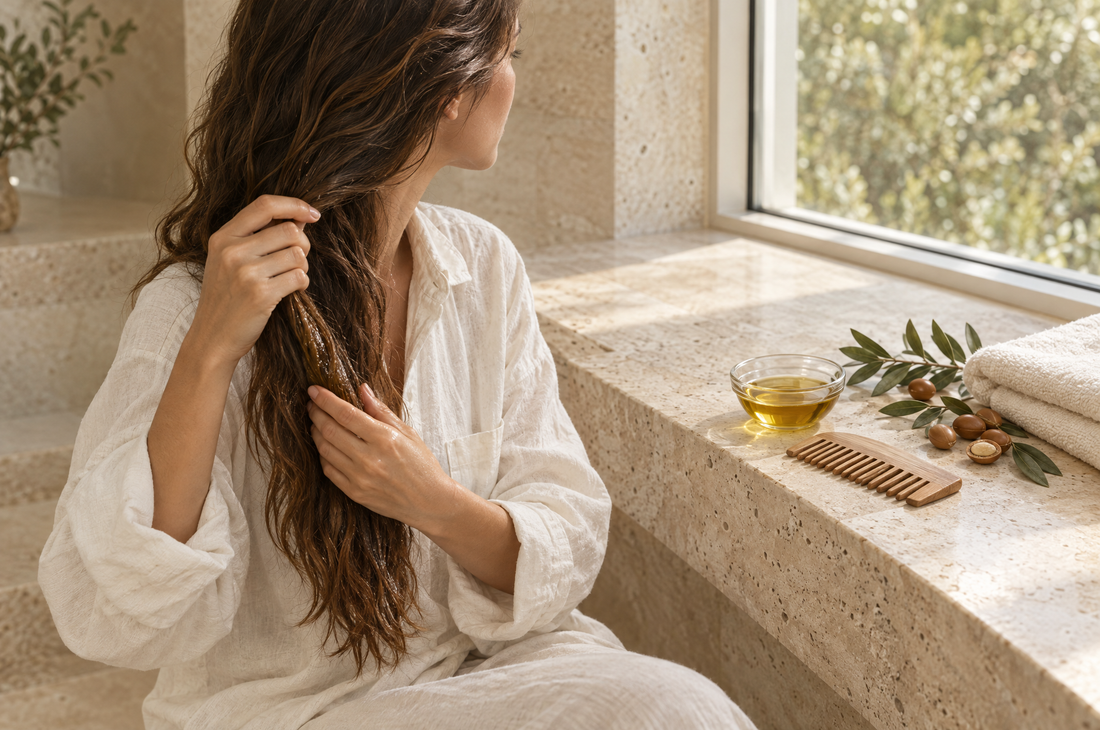
- Apply about half a teaspoon of your diluted blend along the partings with a dropper, focusing on areas where you notice thinning.
- Massage with your fingertips for two or three minutes, using small circles and light pressure, not your nails.
- Leave it on for a few hours or overnight, with an old towel over your pillow.
- Shampoo it out the next morning; you may need to lather twice.
- Finish the lengths with a drop of plain argan oil through the ends.
- Take a monthly photo in the same light. Changes, if any, are slow.
Who should skip it or check first
- Anyone with a broken, inflamed or flaking scalp. Damaged or inflamed skin is more likely to react to oils.3 Get dandruff or scaling looked at first; our guide to dandruff and dry scalp explains why oil isn't always the fix.
- Young children. They are more sensitive to essential oils; ask their doctor first.3
- Pregnant or breastfeeding people, and anyone with a medical condition: check with your doctor before using essential oils.
- Anyone who reacts. Contact dermatitis from rosemary oil is uncommon but possible.2 Stop if you get itching, redness or a rash.
Never swallow essential oils or use them near the eyes.3
When to see a dermatologist instead
Sudden shedding, patchy bald spots, a painful or scaly scalp, or thinning that keeps progressing all deserve a proper diagnosis. Hair loss has many causes, and the AAD notes that the earlier treatment starts, the more likely regrowth is. Proven options exist: minoxidil can help early hair loss, though results take about six to twelve months.4 A dermatologist can tell you whether a rosemary routine is a reasonable add-on or a distraction from something that needs treating.
Frequently asked questions
What is the best carrier oil for rosemary oil?
Any gentle, plain plant oil works. Argan oil is a good choice for the scalp because it is light, mild-smelling and spreads easily; jojoba and sweet almond oil are other common options. Choose a single-ingredient oil with no added fragrance.
How many drops of rosemary oil per tablespoon of carrier oil?
About 3 to 6 drops of rosemary essential oil per tablespoon (15 mL) of carrier oil gives a 1 to 2 percent blend, a sensible range for the scalp. Safety guidance treats up to 5 percent, roughly 15 drops per tablespoon, as the usual upper limit.
Can I leave rosemary and argan oil in my hair overnight?
Most people can, provided the blend is diluted and your scalp doesn't react. Protect your pillowcase, shampoo it out in the morning, and stop if you notice itching, redness or flaking.
Does rosemary oil really work as well as minoxidil?
One six-month trial in 100 men found similar small gains with a rosemary oil lotion and 2% minoxidil, with no placebo group for comparison. It is a promising but thin result, and it doesn't prove that a home-mixed blend will work.
Can I put rosemary oil directly on my scalp?
No. Rosemary essential oil is concentrated and should always be diluted in a carrier oil before it touches skin, and kept away from the eyes.
Sources
- Panahi Y, Taghizadeh M, Marzony ET, Sahebkar A. Rosemary oil vs minoxidil 2% for the treatment of androgenetic alopecia: a randomized comparative trial. Skinmed. 2015;13(1):15–21. Link
- Gupta AK, Wang H, Wang T, Talukder M. Do non-prescription products help in managing androgenic alopecia? Skin Appendage Disord. 2025;11(3):270–281. Link
- Mayo Clinic. Essential oils: aromatherapy safety. Patient education handout MC5574-120rev0918. Mayo Foundation for Medical Education and Research. Link
- American Academy of Dermatology. Hair loss: diagnosis and treatment. Link
- Lin TK, Zhong L, Santiago JL. Anti-inflammatory and skin barrier repair effects of topical application of some plant oils. Int J Mol Sci. 2017;19(1):70. Link
- American Academy of Dermatology. How to test skin care products. Link
This article is for general information and isn't medical advice. If you're losing hair, have a scalp condition, or are pregnant or breastfeeding, check with your doctor or dermatologist before trying something new.