Why Moisturizing Matters: How to Keep Your Skin Hydrated

If you only had time for one step in your skincare routine after cleansing, most dermatologists would point you toward moisturizer (and, in the morning, sunscreen). Moisturizing isn't glamorous, but it does real work: it keeps the outer layer of skin supple, helps it do its job as a barrier, and makes almost every other skin concern easier to manage. Here is why it matters, how it works, and how to do it well.
The short answer
Moisturizing matters because it helps the outer layer of your skin hold on to water. Moisturizers both add moisture and slow its loss, which keeps skin soft, comfortable and better able to act as a barrier. Every skin type benefits; the best time to apply is right after washing, on damp skin.
Why is it important to moisturize your skin?
Your skin's outermost layer, the stratum corneum, works like a wall of flattened cells held together by fats. When it has enough water and lipids, it is flexible and keeps irritants out. When it dries out, it becomes rough, flaky and more easily irritated.
Moisturizers help in two ways: they put moisture into the skin and they help prevent water from leaving it1. That is why a review of moisturizers in dermatology describes them as addressing both a disrupted skin barrier and low water content in the outer skin, and as having a place in both preventing and managing several types of dermatitis2.
Softer, more comfortable skin
The most immediate benefit is the one you can feel. Moisturized skin is smoother and less tight, itchy or flaky.
Support for the skin barrier
A well-hydrated outer layer is better at keeping water in and irritants out. If your skin often stings or turns red when you apply products, a gentle, fragrance-free moisturizer is a good place to start3.
A more youthful look as skin ages
Skin becomes drier with age, and dryness makes fine lines more visible. The American Academy of Dermatology (AAD) notes that moisturizer traps water in the skin, giving it a more youthful appearance4. It won't stop aging, but it does help skin look its best, alongside daily sunscreen4.
Easier-to-manage skin conditions
Moisturizers are a cornerstone of care for conditions such as atopic dermatitis (eczema)2. They also matter for acne: common acne treatments such as benzoyl peroxide, salicylic acid and retinoids tend to dry and irritate the skin, so the AAD advises people using them to moisturize5. If you have a skin condition, a dermatologist can tell you which type of moisturizer suits your treatment.
Does oily skin need moisturizer?
Often, yes, though it depends. Drying out oily skin with harsh products isn't the answer. The AAD notes that when skin becomes dry, the body can make more oil, which can lead to clogged pores and breakouts5. At the same time, people with oily skin may not need much: the AAD suggests a lightweight gel, or even skipping moisturizer if your skin doesn't feel dry, and treating combination skin zone by zone1. Look for products labeled oil-free, non-comedogenic or "won't clog pores"5.
How moisturizers work: three types of ingredients
Most moisturizers combine three kinds of ingredients. Knowing which is which helps you choose.
| Type | What it does | Examples |
|---|---|---|
| Humectants | Draw water into the outer layer of skin | Glycerin, hyaluronic acid |
| Emollients and lipids | Fill gaps between skin cells so skin feels smoother | Ceramides, many plant oils |
| Occlusives | Form a layer that slows water loss | Petrolatum, mineral oil |
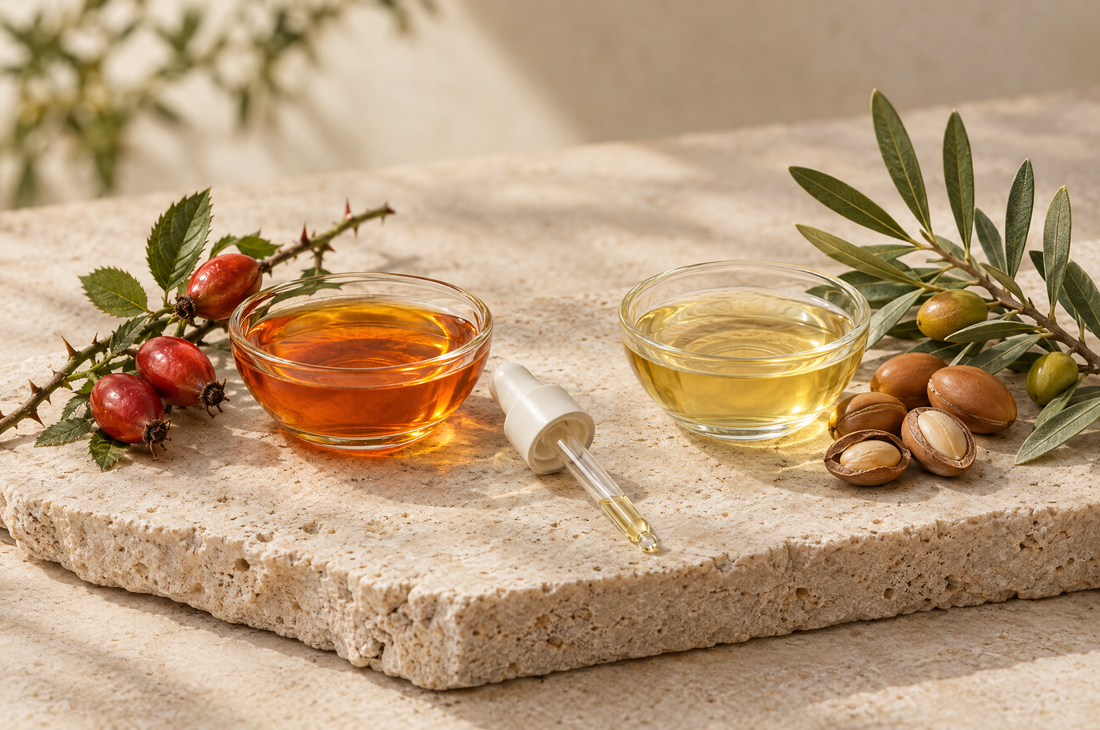
The AAD recommends looking for lipids such as ceramides, humectants such as glycerin and hyaluronic acid, and occlusives such as mineral oil or petrolatum6. Plant oils like argan sit between emollient and light occlusive: they soften the skin and slow water loss, but they don't draw water in the way a humectant does. That is why an oil works best on damp skin or over a water-based moisturizer.
When should you moisturize?
- Right after bathing or washing your face. Apply moisturizer while skin is still damp to trap water3,5.
- Morning and night for your face, with sunscreen as the last step in the morning.
- After washing your hands, every time if you can; keep a hand cream by the sink6.
- After shaving or waxing, when skin is more easily irritated.
- More often in cold, dry weather, when indoor heating pulls moisture from the air; a humidifier can help too3.
How to choose the right moisturizer for your skin type
The AAD's general rule: the thicker the product, the more moisturizing it is. Gels are lightest, then lotions, then creams, and ointments are thickest and most effective for very dry skin1.
- Dry skin: a cream or ointment rather than a lotion1,3.
- Normal skin: a lotion is usually enough, with something richer in winter1.
- Oily skin: a light gel, or none if you don't feel dry1.
- Combination skin: moisturize dry areas and go lighter on the T-zone1.
- Mature skin: many people need a cream-based moisturizer as skin holds less water1.
- Sensitive skin: choose fragrance-free; "unscented" products can still contain masking fragrance3.
Where does argan oil fit in?
A pure plant oil isn't a complete moisturizer on its own for everyone, but it can be a very good part of a moisturizing routine. Argan oil has some human evidence behind it: in a 60-day study of postmenopausal women, applying it to the skin reduced water loss and increased the water content of the outer skin compared with baseline7. A review of plant oils notes that linoleic acid, one of argan oil's two main fatty acids, helps maintain the skin's water barrier8.
Ways to use it:
- As the last step on your face: 2 to 3 drops pressed in over your moisturizer at night. See how to use argan oil on your face.
- As a body oil: 5 to 6 drops smoothed over damp skin after a shower. Our guide to argan oil as an after-shower body oil has more detail.
- Mixed into your cream: a drop or two added to your usual moisturizer for extra richness.
- On hands, cuticles and heels: a few drops at night.
If you'd like to try it, our 100% organic argan oil is a single ingredient, cold-pressed in Morocco, with no fragrance, chemicals or dyes, which makes it easy to add without worrying about irritating extras. For more on layering, see argan oil before or after moisturizer, and for dry skin specifically, argan oil for dry skin.
When to see a dermatologist
If your skin stays dry, cracked or itchy even after you've improved your routine, it may be more than everyday dryness. The AAD recommends seeing a board-certified dermatologist when dry skin doesn't improve, since conditions such as atopic dermatitis or psoriasis can be the cause3.
Frequently asked questions
Is it necessary to moisturize every day?
For most people, yes, at least once a day and after washing. Very oily skin may need only a light gel, and some people can skip it on days their skin doesn't feel dry.
Is it better to moisturize at night or in the morning?
Both have a place. Morning moisturizer sits under sunscreen; night is a good time for richer products and face oils.
Can a face oil replace moisturizer?
For some people with normal skin, yes. Many people get better results using a water-based moisturizer and then an oil on top, especially if their skin is dry.
Should you moisturize oily skin?
Usually, but lightly. A gel or oil-free, non-comedogenic product helps without feeling heavy, and drying out oily skin with harsh products tends to backfire.
Why does my skin still feel dry after moisturizing?
You may need a thicker product, to apply it on damp skin, shorter and cooler showers, or a humidifier. If dryness persists, see a dermatologist.
Sources
- American Academy of Dermatology. How to pick the right moisturizer for your skin. Link
- Purnamawati S, Indrastuti N, Danarti R, Saefudin T. The role of moisturizers in addressing various kinds of dermatitis: a review. Clin Med Res. 2017;15(3-4):75–87. Link
- American Academy of Dermatology. Dermatologists' top tips for relieving dry skin. Link
- American Academy of Dermatology. Skin care in your 40s and 50s. Link
- American Academy of Dermatology. Moisturizer: why you may need it if you have acne. Link
- American Academy of Dermatology. 4 skin care tips for your hands. Link
- Boucetta KQ, Charrouf Z, Derouiche A, Rahali Y, Bensouda Y. Skin hydration in postmenopausal women: argan oil benefit with oral and/or topical use. Prz Menopauzalny. 2014;13(5):280–288. Link
- Lin TK, Zhong L, Santiago JL. Anti-inflammatory and skin barrier repair effects of topical application of some plant oils. Int J Mol Sci. 2017;19(1):70. Link
This article is for general information and isn't medical advice. If you have a skin condition such as eczema, psoriasis or acne, check with your dermatologist about which moisturizer is right for you.